Case file 001
A brand-new website got named by Google's AI in nine days
Jittapatana "Patrick" Prayoonpruk · Founder, Nexloom
When someone asks an AI about the problem your business solves, does it only ever name the big players?
Short answer
No. A page on a website that was nine days old, with no advertising and no links bought, was named as a source in Google's AI answer on 11 August 2026. Nexloom ran the test on its own site so the whole record could be published, including what went wrong.
- Our own property
- jittapatrick.com
- Prepared
Watch the full walkthrough
11:19
Eleven minutes on what it took: a month spent building for a phrase nobody types, one day of checking that killed the plan, an AI that named the wrong person as the owner, and a competitor with a thousand pages already published. Then nine days from publishing the right page to being quoted.
Key moments
- The result, first
- A site with nothing wrong with it that nobody found
- One day of checking, and the phrase nobody types
- Real demand, wrong people
- Killing the best thing I wrote
- An owner who does not exist, and a competitor with a thousand pages
- The two boring changes
- Nine days to being quoted
- Why I left the page alone
- What this does not prove
The numbers
9 days
From publishing the page to Google's AI quoting it
Screenshots, 2 and 11 August · One page, one Thai question ·
No. 3
Where the page sat, above a Reddit thread on a far bigger domain
Google Thailand, read twice · Query: claude code เสียเงินไหม ·
2.06M
Other websites linking to the Reddit domain it outranked
Toolbar reading on the results page · Measured on the competing row ·
+1,875%
The rise Search Console flagged on its own, afterwards
Google Search Console's own alert · Impressions on one page. Google chose the period and the comparison. ·
We picked the worst possible site to test it on
AI answers do tend to quote the names everybody already quotes, so we ran the test on a site we own and made the conditions as unfair to ourselves as we could:
- A brand-new domain with no history and effectively nothing linking to it.
- Thai. It is written without spaces between words, so a machine has to work out where each word ends before it can read a sentence.
- One of the most crowded subjects online: teaching people to use AI coding tools.
- One person, part-time, no ad budget, no outreach.
If a site like that can get named, “AI only quotes big brands” describes what happens when nobody does the work.
First month: nothing wrong, and nobody found it
For the first month the site was a shop. A homepage, one thing to sell, one button. Every visitor arrived from social media. Search sent nobody. Not a few people. Nobody.
Nothing was broken. Everything a search engine needs was already working.
What the site actually was, technically
Sitemap auto-generating, robots.txt allowing the AI answer engines, canonical tags, social tags, structured data and security headers all in place, Search Console connected. Pre-rendered pages, no slow database call in front of a reader.
None of this is why the page got cited. It is listed so the record is complete, and because a site that returns errors or loads slowly never gets the chance to be cited at all.
One day of checking beat a month of guessing
We had a plan. Fifteen articles, written from instinct. Everyone we showed it to agreed it was good, and the whole site sat on one idea: teaching people to build a website using AI.
Before writing any of it, we did something cheap. We typed our phrases into Google and watched what it offered back. No expensive tools. Google tells you for free what people actually type.
The phrase the entire business was built on returned nothing. Not rarely. Never. Nine of the fifteen planned titles returned nothing at all, and two of them were already sitting on the site as drafts, waiting for an audience that does not exist.
How the checking actually worked, and three traps in it
Google’s own autocomplete, queried directly in Thai, in six rounds: base phrases, then every letter of the alphabet appended to each one, then topic probes. Raw results filtered by hand for words that mean two things.
Three traps, each of which would have quietly ruined the list:
Thai has two ways to write the same word. Google returns one form where a person types the other. Same word to a reader; the two do not match as text. Any script comparing what people search against what you wrote misses every one of them unless it normalises first.
English looked bigger, and would have been a trap. The first shortlist was 66 English phrases against 75 Thai. English has real volume, and it would have meant competing against the entire English-language internet from a standing start. Every row got a language tag and the list was rebuilt Thai-only.
Words that mean two things. “AI” on its own in Thai pulls a phone network, an insurance company, an aircraft manufacturer and a shoe brand. Filtered by hand.
The harvest produced 2,930 phrases, narrowed to 141 worth a second look, then to a 75-phrase target list.
Real demand, wrong people
This is the part that changed how we think about all of it, and no tool will show it to you.
Some phrases had plenty of demand. Real people, really searching. Just not the people we pictured.
| The phrase | Who we assumed | Who is actually searching |
|---|---|---|
| “website not secure” | Owners wanting it fixed | Their customers, seeing a browser warning and wondering if they are about to be robbed |
| “website design” | People looking to hire | Mostly students hunting for exam papers and presentation templates |
Chase the numbers and you write two beautiful articles for people who were never going to buy anything. The demand was real. The humans were wrong.
The AI said the site belonged to someone who does not exist
We now check one thing for every client before anything else, and this is why.
We asked an AI to read the homepage and tell us who runs it. It answered with a full name. That person does not exist. There was a video channel handle on that page, and it was the only thing on the entire homepage shaped like a human name. So the machine took it and decided that was the owner.
The fix was small: a real name on the page, with real credentials somewhere a machine can read them, and the channel labeled as a show.
A competitor with a thousand pages
The same day, we looked at who we would be competing with. One of them had over a thousand articles already published, organized into exactly the categories we were planning to use. We had six.
You cannot out-publish someone with a thousand pages. If you are running a business and writing this yourself at night, you were never going to win that race.
The good news is that you do not have to. What was left was narrower: a real person with a real name on the pages, teaching one specific group: business owners who do not write code. A smaller room, and a room you can actually win.
The two changes that did the work, and both are boring
Most pages make you work for the answer. You land, you scroll, you get the author’s life story, and somewhere near the bottom is the thing you came for.
Every page opens with the answer. Two sentences, in their own box, before anything else, and nothing is allowed to touch that box. A machine building an answer is looking for a sentence it can quote. If it has to assemble one out of paragraph seven and a table halfway down, it will not. It will find a page that already did that work.
Which means the fix is usually not writing more. It is moving one paragraph to the top of something you have already written.
Answer every version of the question. People ask the same thing five ways. The page that got cited carries eight of them.
Nine days
On 2 August the page went live. A seventeen-minute answer to a question about what a tool costs. Five days later it was sitting at position 3. Four days after that, Google stopped showing a list and answered the question itself, naming the page as one of its sources.
The page that earned it was the boring one about price, the one the data told us to write. The original argument we were proud of had no measurable demand, so it got pulled from the first wave.
That exact question was written into the page as target number six, nine days before Google answered it. The page was pointed at it on purpose. We just did not know whether it would work.
Then we left the page alone for three weeks
Once it started performing we had three improvements ready, and we shipped none of them. Not to protect the ranking. Editing a page does not by itself cost you position. We left it alone so that if the page moved, we would know what moved it.
The rule we wrote down, and the one exception in it
The reason we could afford to wait is narrower than it looks: change five things at once and the page moves, and you will never know which one did it. Then you are standing in front of a client telling them all five worked.
With one exception written into the rule so it could not be abused: corrections never wait. A wrong fact on a page about money gets fixed the day it is found. Improvements wait for the measurement window.
That is the difference between a case study and a testimonial. We wrote down, in advance, what would make our own result unreadable.
Three weeks earlier, none of these questions had an AI answer
Back in July, not one of the five questions we were targeting had an AI answer on it at all. Three weeks later, they did.
It is moving under your industry too, and it will not wait.
The evidence, in order
Every image carries its query and its date. Open Google and type the same thing. If the result has moved, that is what should happen. A ranking is a photograph of one moment.
claude code เสียเงินไหม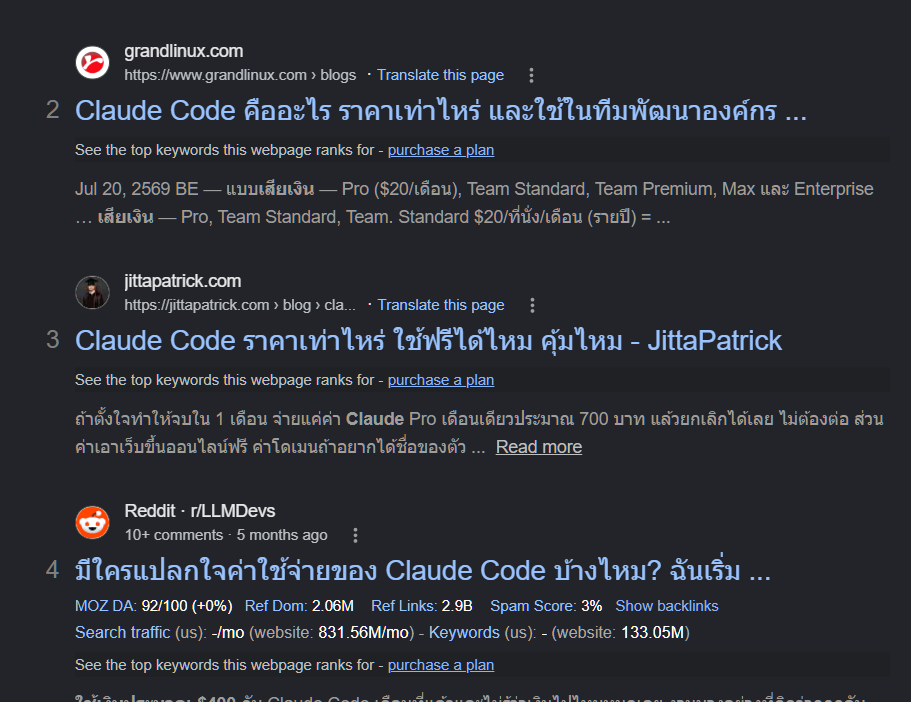 Open the original
Position 3, above a Reddit thread on a domain that 2.06 million other websites link to. Our site had almost nothing linking to it.
claude code เสียเงินไหม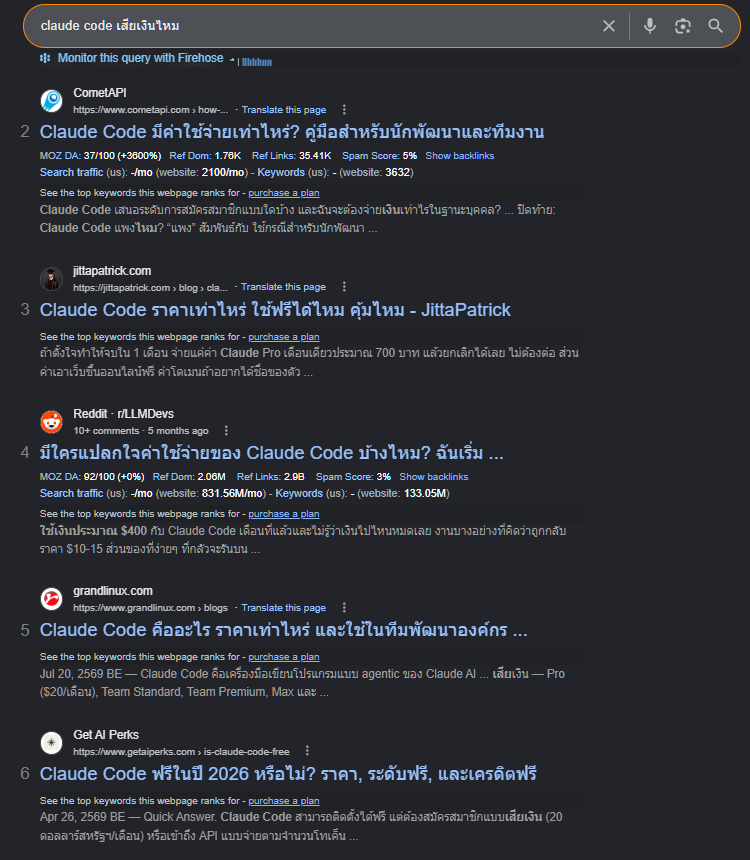 Open the original
The same search seven minutes later. Everything around it moved. Position 3 did not.
claude code เสียเงินไหม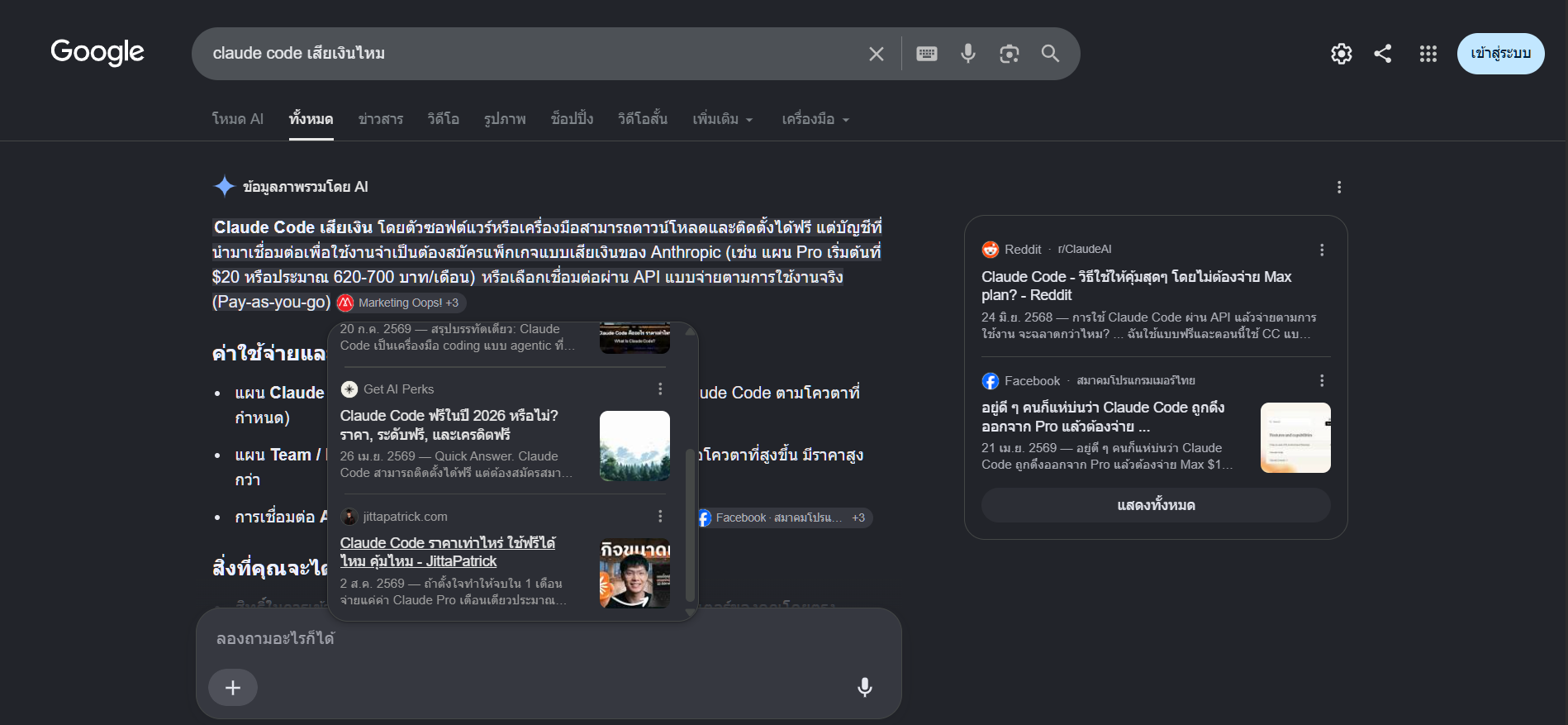 Open the original
Four days later Google stopped showing a list and answered the question itself, naming this page as one of the sources it used.
claude code ต้องเสียเงินไหม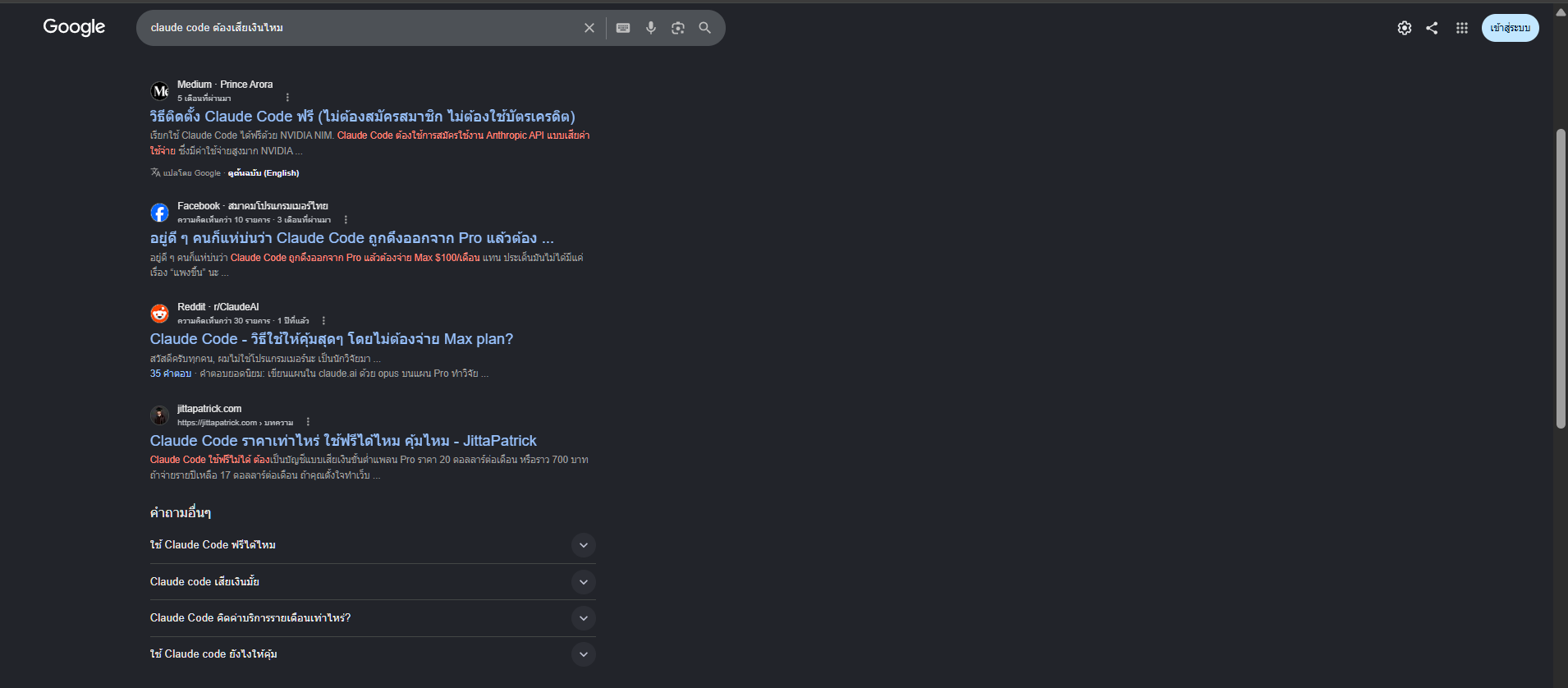 Open the original
Two days later somebody asked the same thing in different words. The same page came back. One page ranking once is luck; twice, for two phrasings, is something else.
claude code เสียเงินไหม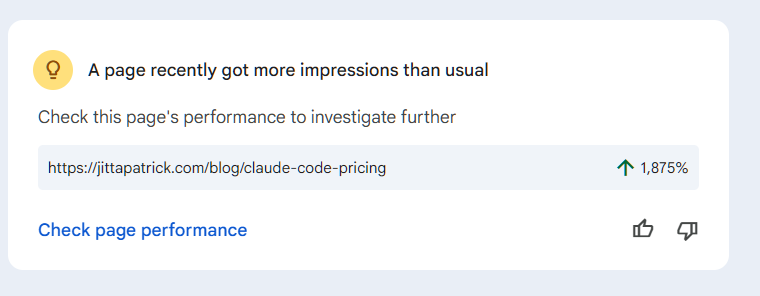 Open the original
Afterwards, Search Console flagged the page on its own for unusually high impressions.
What this proves, and what it does not
- What was measured
- One Thai-language question on Google Thailand, watched from the day the page went live until Search Console reported on it.
- Window
- –
Supported by the record
- A nine-day-old page on a brand-new site was named as a source in a Google AI answer.
- It sat above a Reddit thread on a domain that 2.06 million other websites link to.
- The question it was cited for had been written into the page on purpose, nine days earlier.
- The same page came back for a second, differently worded version of the question.
- All of it happened in Thai, with no advertising and no links bought.
Not measured
- That ranking third caused the citation. Those are two things that happened in that order.
- That any one change was the deciding factor. Several were made at once.
- That the same approach works for a commercial or a local search.
- Clicks, inquiries or revenue. The site has recorded no sales.
- Anything about ChatGPT, Perplexity or Claude. Only Google was checked.
What you can copy
Four things from this case you can do yourself, without hiring anyone.
- 1
Put the answer at the top of the page, in its own box, before anything else. Most pages bury it, and a machine building an answer will take the page that did not.
- 2
Answer every version of the question. People ask the same thing five or six ways, and being the only page that covers all of them is how you become the one that gets quoted.
- 3
Open an AI today and ask it who runs your business. If it names the wrong person, or nobody, fix that before you write anything else. Being named as the wrong person is worse than not being named.
- 4
Before writing anything, type your topic into Google and read what it offers to complete. It is free, it takes an afternoon, and it will tell you which of your ideas nobody is searching for.
Questions people ask about this
- Can a brand-new website get cited by AI?
- On one occasion, yes. A page published on a nine-day-old site with no advertising and no bought links was named as a source in Google's AI answer on 11 August 2026. That is one result on one question in one language.
- Does AI only quote big brands?
- It often does, because big brands have usually done the work. In this test a site nobody had heard of was quoted above a Reddit thread on a domain that 2.06 million other websites link to, so size is not the only thing that decides it.
- How long does it take for a new site to be cited by AI?
- In this case, nine days from the page going live to being named as a source. That was one page on one question, after a month of earlier work on the site that produced no search traffic at all.
- Do you need backlinks to get cited by AI?
- Not in this test. The site had effectively nothing linking to it and no outreach was done. Whether that holds on a more competitive question was not measured.
- Does this work for ChatGPT as well as Google?
- Unknown. Only Google was checked, on one date. ChatGPT, Perplexity and Claude were never tested here, and this case says nothing about them.
- Does this only work in a smaller language like Thai?
- This test ran in Thai, which is the harder direction. Thai is written without spaces between words, so a machine has to work out where each word ends before it can read anything. Whether the same result comes in English was not tested.
- Did being cited bring in customers?
- No. The site has recorded no sales. Impressions rose sharply and Search Console said so, but clicks, inquiries and revenue were never measured. Being named is not the same as being hired.
- What is the first thing to change on my own site?
- Move the answer to the top of a page you already have. The change that did the most here was putting a clean two-sentence answer in a box before anything else on the page.
Who ran this

Jittapatana "Patrick" Prayoonpruk
Founder, Nexloom
- B.S. Computer Science, California State University Northridge, summa cum laude with minors in Data Science and Mathematics
- Research team 2024-2025, NASA-sponsored BORACLE project at CSUN ARCS
- Lead author, IEEE CCWC 2026
- AEO Fundamentals, HubSpot Academy
- Google Analytics Certification (2026), Google Skillshop
Find out what AI says when someone asks about your business
Thirty minutes. We look together at who gets named in your market right now, and why.